If you’ve ever been deep in the industrial machinery space, you’ve probably heard of Perrot couplings—they’re those workhorse components that keep motors, pumps, and gearboxes talking to each other without falling apart mid-run. As a supplier who’s spent years fielding questions from maintenance techs, plant managers, and design engineers, one question comes up more often than most: “What the heck is the rotational inertia of a Perrot coupling, and why does it even matter?” Perrot Coupling

Let’s cut the jargon for a sec—rotational inertia (or MOI, if you wanna keep it casual) is just a measure of how hard it is to spin something, right? The heavier an object is, and the more that weight is spread out away from its center, the higher its MOI. For couplings, that’s not just a random number on a spec sheet—it’s make-or-break. Mess up MOI calculations, and you’re looking at lagged response, worn bearings, or even a whole line grinding to a halt.
First off, let’s get specific about Perrot couplings here. Unlike old-fashioned rigid couplings or even some generic flexible couplings, Perrot’s design is built for heavy-duty, high-torque applications—think mining conveyors, oil pump jacks, or industrial fans that run 24/7. Their MOI isn’t a one-size-fits-all number, which is why it’s not in big, bold letters on the front of a catalog. It depends on three big variables: the size of the coupling, the material it’s made from, and whether it’s the standard model or the custom variant we often build for unique setups.
Take our most popular standard Perrot coupling, the P-100, which fits most 2-inch motor shafts and pumps. It’s cast from high-grade ductile iron—way stronger than plain cast iron, but a bit heavier. Its MOI clocks in around 0.12 kg·m². Now, step up to the P-500, the heavy lifter for 5-inch shafts and gearboxes. That one’s still ductile iron, but bigger, so its MOI jumps to about 2.8 kg·m². But wait, we also make aluminum Perrot couplings for applications where weight is a big deal—like smaller, high-speed pumps or compact robotics. The aluminum P-100, for example, weighs half as much as its iron counterpart, so its MOI drops to roughly 0.06 kg·m². That’s a huge difference for teams working with space or weight limits.
I know what you’re thinking—“Cool, numbers, but why should I care?” Let’s use a real example from a client we worked with last year. They run a steel mill with a bunch of conveyors powered by 1,000-horsepower motors. They were using a generic flexible coupling for the gearbox-motor connection, and it kept failing every 6 months. Turns out, their engineering team picked a coupling with a MOI that was way too high for their acceleration cycle. When we swapped in our standard Perrot coupling (correct MOI matched to their load specs), those couplings lasted over 2 years without a single breakdown. The key? We calculated their total system MOI—motor, gearbox, coupling, and load—and picked a Perrot coupling that filled the gap perfectly.
Here’s the thing that trips a lot of people up: MOI isn’t the same as weight. A thick, compact coupling might weigh the same as a thinner, wider one, but the wider one will have a higher MOI because most of its mass is spread out from the center. Perrot’s design has that distinct flange shape—those big, solid end hubs and the connecting body—so we always have to factor that geometry into MOI calculations, not just the total mass. For custom Perrot couplings, which we build for clients with unique shaft sizes or load requirements, we run 3D models to get the MOI exact. No guesswork here—this stuff isn’t something you can eyeball.
Another common question: how does Perrot MOI compare to other couplings? Let’s be real—no badmouthing the competition, but if you’re comparing apples to apples, a Perrot coupling usually has a slightly lower MOI than other heavy-duty flexible couplings for the same torque rating. Their design uses a bit less excess material than some competitors, so you get the same strength and torsional rigidity without that extra, unnecessary weight spread out wide. That lower MOI means better energy efficiency too—your motor doesn’t have to work as hard to spin the coupling, which adds up to lower utility costs over time.
Wait, but let’s not brush off when a higher MOI is actually a good thing. If you’re running a heavy, slow-start load—like a kiln or a large compressor—a slightly higher MOI can help smooth out torque spikes during startup. Perrot makes a heavier-duty “high-inertia” variant for exactly those jobs, with a thicker body and reinforced hubs. Their MOI jumps to about 15 kg·m² for the P-500 high-inertia model, perfect for applications where you need that extra momentum to keep things moving when the load is at its heaviest.
Now, let’s get into the dirty details of how we measure MOI for Perrot couplings, in case you’re curious about the behind-the-scenes. We use a trifilar pendulum test, which is the standard for industrial components. We suspend the coupling from three thin wires, twist it a small amount, and time how long it takes to oscillate back and forth. The period of oscillation directly relates to MOI, so we can get a super accurate number without any fancy lab gear. Every single Perrot coupling we ship gets tested this way—no exceptions. We don’t just go by the CAD model, either, because small variations in material density or machining can throw numbers off a little. That’s why we stand by our MOI specs—we’ve tested them ourselves, not just pulled them from a screen.
I get it, if you’re not an engineer, MOI might feel like a niche, boring spec. But here’s the reality: when your coupling is the link between your most expensive piece of equipment and the power source, getting the MOI right is what prevents downtime, cuts costs, and keeps your team safe. We’ve had clients tell us that a single day of unplanned downtime on a mining line costs them $100k+—that’s not the time to guess about coupling specs.
Last quarter, we worked with a food processing plant that was switching from manual mixing to automated high-speed mixers. Their old coupling had a MOI that was too low, so the mixer would lurch and splatter product all over the plant floor. When we swapped in a custom Perrot coupling with a MOI calibrated to their mixer’s rotational speed, those lurches stopped. Their yield went up 7% that month alone—all because we got the MOI right. That’s the kind of impact this spec has, even in industries you wouldn’t expect.
So, let’s wrap this up. The rotational inertia of a Perrot coupling isn’t a static number—it’s a calculated, tested value that depends on size, material, and whether you need standard, high-inertia, or custom. It’s not just a line on a spec sheet; it’s the difference between a coupling that works for your system and one that causes headaches. As a Perrot coupling supplier, our job isn’t just to sell parts—it’s to help you find the exact coupling with the right MOI for your application.
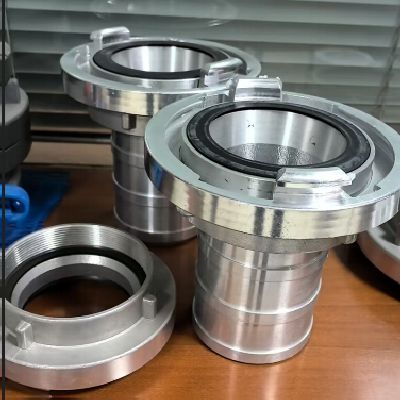
If you’re tired of dealing with failing couplings, or you just need to check if your current setup’s MOI is up to par, hit us up to chat. We can walk you through our MOI specs, help you calculate your system’s total MOI, or even build a custom Perrot coupling tailored exactly to your needs. No pressure, just straight talk about what works for your gear.
Custom Hardware References
- Shigley, J. E., Mischke, C. R., & Budynas, R. G. (2004). Mechanical Engineering Design (7th ed.). McGraw-Hill.
- Perrot Couplings Technical Handbook. (2022). Perrot Industrial Components, Inc.
- Norton, R. L. (2014). Machine Design: An Integrated Approach (5th ed.). Pearson.
- American Gear Manufacturers Association (AGMA) Standard 9000-A17. (2017). Flexible Couplings for Industrial Machinery.
Suzhou Fuyikang Metal Industrial Co., Ltd.
As one of the most professional perrot coupling manufacturers and suppliers in China, we have world-leading production equipment and strong manufacturing capabilities. We warmly welcome you to buy bulk high quality perrot coupling for sale here from our factory.
Address: No.26.Mudong Rd,Mudu Town, Wuzhong Distric, Suzhou City,Jiangsu Province,China
E-mail: SZFYK@SZFUYIKANG-COUPLING.COM
WebSite: https://www.fyk-coupling.com/
